What Is Pool Leak Detection?
Swimming pools naturally lose a small amount of water to evaporation and splash-out. However, when water levels drop by more than a quarter-inch per day, or your autofill valve runs continuously, an active leak is draining hundreds of gallons into the soil, risking pool deck subsidence and soil destabilization.
Whether you manage a residential home or commercial property in Whittier, catching water loss early preserves structural integrity and halts soaring utility costs. Learn more in our complete guide to water leak detection in Whittier, CA.
Seeing these signs? Don’t wait for the damage to spread. A local pro can pinpoint the leak before anything is opened up.
Call (562) 245-5818Signs You May Need Pool Leak Detection
Losing more than the bucket test
The pool drops faster than the bucket over the same period.
Autofill runs constantly
The fill valve seems to run often, or the water bill rose during swim season.
Wet ground near the pool or equipment
Soggy soil, settling deck, or damp areas around the equipment pad.
Cracks or loose tile
New cracks in plaster, gaps at the tile line, or loose coping.
Air in the system
Air bubbles at the returns or a pump that loses prime can indicate a suction-side leak.
Algae or chemistry problems
Frequent fresh water dilutes chemicals, making balance hard to maintain.
Leak or evaporation? Try the bucket test
This at-home comparison is the standard first step:
- Set a bucket on the pool steps or a stable spot so it sits in the water, and fill it until the water inside matches the pool level.
- Mark the water level inside the bucket and the pool level on the outside of the bucket (or on the tile).
- Run the pump on its normal schedule and turn off any autofill. Wait about 24 hours without swimming.
- Compare. If the pool dropped noticeably more than the water in the bucket, a leak is likely. Repeating the test with the pump off can hint at whether the leak is in the pressure-side plumbing.
Where pools usually leak
- Skimmer — cracks or separation where the skimmer throat meets the pool shell are very common.
- Light niche — gaps around the light housing or the conduit behind it.
- Return and suction fittings — seals around wall fittings and the main drain.
- Shell and tile line — cracks in plaster or the bond beam.
- Underground plumbing — suction and return lines running between the pool and the equipment.
- Equipment pad — pump seals, filter, heater connections, and valves. Look for dampness around the equipment first.
An autofill valve can mask a leak by quietly topping up the pool, so a higher water bill may be the first sign.
How a pool leak is pinpointed
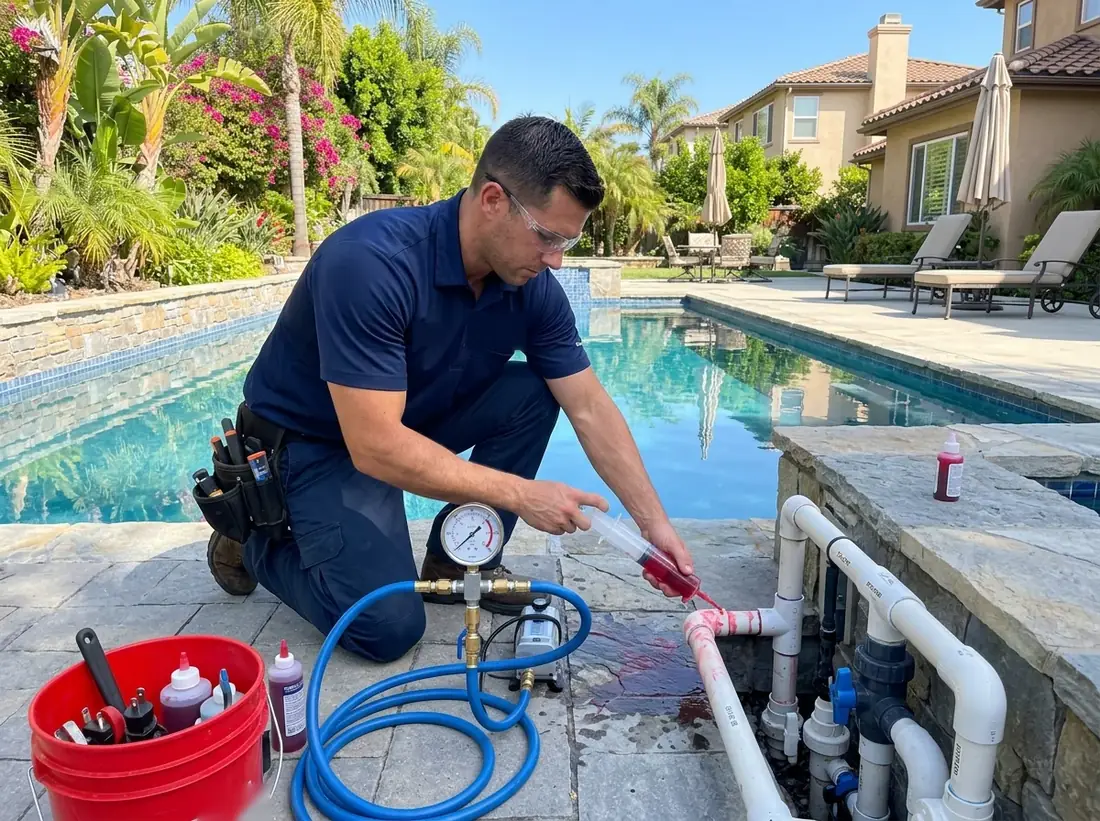
Pool leak specialists typically combine a visual inspection, dye testing at suspected spots (dye is drawn into a crack or fitting that is leaking), pressure testing of each plumbing line, and listening equipment designed for pools. Some inspect the shell and fittings while in the water. Spas are tested the same way and are often checked at the same visit.
Tools Our Specialists Use
- Bucket Evaporation Benchmark Test. Compares pool water drop against an isolated bucket to calculate true leak vs. evaporation rates.
- Hydrostatic Line Pressure Testing. Plugs skimmer, main drain, and return jets to test each line individually under pressure.
- Precision Dye Testing at Shell Breaches. Dispenses specialized colored dye near suspected skimmer cracks, underwater lights, and drains to observe dye draw.
- Electronic Vinyl & Shell Scanners. Detects electrical current grounding through microscopic tears in pool shells.
What a Visit Usually Covers
- Review of your bucket test and recent water use
- Inspection of the equipment pad, skimmers, lights, and fittings
- Dye testing and pressure testing of suction and return lines
- A summary of where water is being lost and repair options
Ready to find the leak? A local pro can pinpoint the leak before anything is opened up.
Call (562) 245-5818Pool Leak Detection Across Whittier
We take calls for pool leak detection in every Whittier ZIP code (90601–90610). Each neighborhood page explains the housing types and local conditions that affect how leaks show up there.
Pool Leak Detection FAQs
How can I test if my pool is leaking or just evaporating?
Perform the 'Bucket Test': Fill a 5-gallon bucket with pool water and place it on a pool step. Mark the water level inside the bucket and outside on the pool shell. After 24 hours, compare the two marks. If the pool drop exceeds the bucket drop, you have a leak.
Do I need to drain the pool for leak detection?
No. Diagnostic testing—including dye testing, line pressure testing, and hydrophone listening—is performed with the pool full of water.
How much water loss is normal?
It varies with temperature, sun, wind, humidity, and whether the pool is covered or heated. That’s why the bucket test is useful — it compares your pool against evaporation under the same conditions.
Does the pool need to be full for testing?
Usually it should be at normal operating level. Ask the provider for any preparation instructions when you schedule.
Can a leak be on the pool equipment?
Yes, and it’s one of the easiest to spot. Check for dripping or damp areas around the pump, filter, heater, and valves.
Is repair included?
Many small leaks, such as fittings and minor cracks, can sometimes be sealed during the visit; plumbing line repairs are usually quoted separately. Confirm the scope with the provider.